A few weeks ago, I came across some old folders and notebooks that contained early versions of a song I wrote in 1981. That song, “Plasma Donor Needle Tracks,” was based on experiences I had while living for a couple of months in Minneapolis, Minnesota. In this post, I’m going to look back at those documents and experiences, but the song stands on its own — no background information needed. So, without further ado, here it is (home recording from last year):
When I go out for a night on the town
I go around with my sleeves rolled down
it saves me trouble, saves me trouble
people talk about me behind my back
plasma donor needle tracks
They say I’m a junkie on a heroin high
say I’m gonna do drugs until I die
someday, that’s what they say
they don’t understand the economic facts
plasma donor needle tracks
It’s an easy way to make a buck
thirty dollar bills every time you get stuck
in your arm, don’t do you no harm
and you never got to pay no federal income tax
plasma donor needle tracks
You go on in and lie on the table
in a couple of hours you are able
to go, you got something to show
you got money to buy what you lack
you got plasma donor needle tracks
So when I go out for a night on the town
I go around with my sleeves rolled down
saves me trouble, saves me trouble
the reason why you don’t have to ask
plasma donor needle tracks
But in case you’d like to know where the song came from, keep reading!
The Summer of ’81
It was a memorable time for twenty-year-old me. My year away from college was winding down, and I had had many adventures (for example, my long vagabonding trip to the Southwest and Mexico). The Minneapolis adventure had a lot to do with a woman I knew; she was very sweet, I liked her a lot, and she was living in Minneapolis. I rented a room in house in the neighborhood south of the Chicago and Lake, a major intersection in a part of town that had probably seen better days. I found a part-time job in a small bakery in the Uptown neighborhood. I had plenty a free time time to ride my bicycle (Chain of Lakes is nice) or just walk around the neighborhoods. I took a few guitar lessons (the only lessons I’ve ever had) at a music store in Dinkytown, the small business district beside the University of Minnesota (where Bob Dylan took some early steps in his career; see What Made Dylan Dylan?: Hibbing and Dinkytown in the American Journey). And, of course, I spent a lot time with my girlfriend and her roommates, whose rental house was conveniently located near my job.
To supplement my bakery income, I also donated (sold) blood plasma. At the time, $10 was the going rate per donation. Theoretically, a person could donate twice a week and earn a whopping $20. I went to the plasma center near Chicago and Lake a few times. I also went to the one up near Franklin Avenue, which was a pretty scruffy area. I mostly remember some second hand stores, a couple of used record stores, and on the sidewalk some folks who might have been homeless. The plasma center near Franklin Avenue shared that scruffy feel. And, to me, it looked like the donors there really needed that extra 10 dollars. From that experience, a song was born.
Musical Influences
As a teenager, I was surrounded by the rock and roll of the 70s: Aerosmith, Kansas, Boston, Queen, Pink Floyd, Crosby Still Nash and Young, etc. But for my own music, as I was learning to play the guitar, I gravitated toward early Bob Dylan, Americana folk, and blues. During those teen years, I was able to borrow albums of folk collections (Smithsonian and Library of Congress) from my local public library, albums that included Leadbelly, Woody Guthrie, southern spirituals, prison songs, work songs, and country blues. The two songs (one never finished) that I wrote in the summer of 1981 reflected those influences. Plasma Donor Needle Tracks had a modified blues chord progression, and the other song was a talking blues.
1981 Version
The artifacts that I recently found include a handwritten copy of the original version of Plasma Donor Needle Tracks. The paper looks like it’s from one of those dime-store scratch paper pads with a gum binding. The second and third verses were attempts to sketch some of the characters I saw at the plasma donor centers. I eventually removed those verses, probably because the people seemed like caricatures and not real individuals. But those people are, in fact, what the song is about.
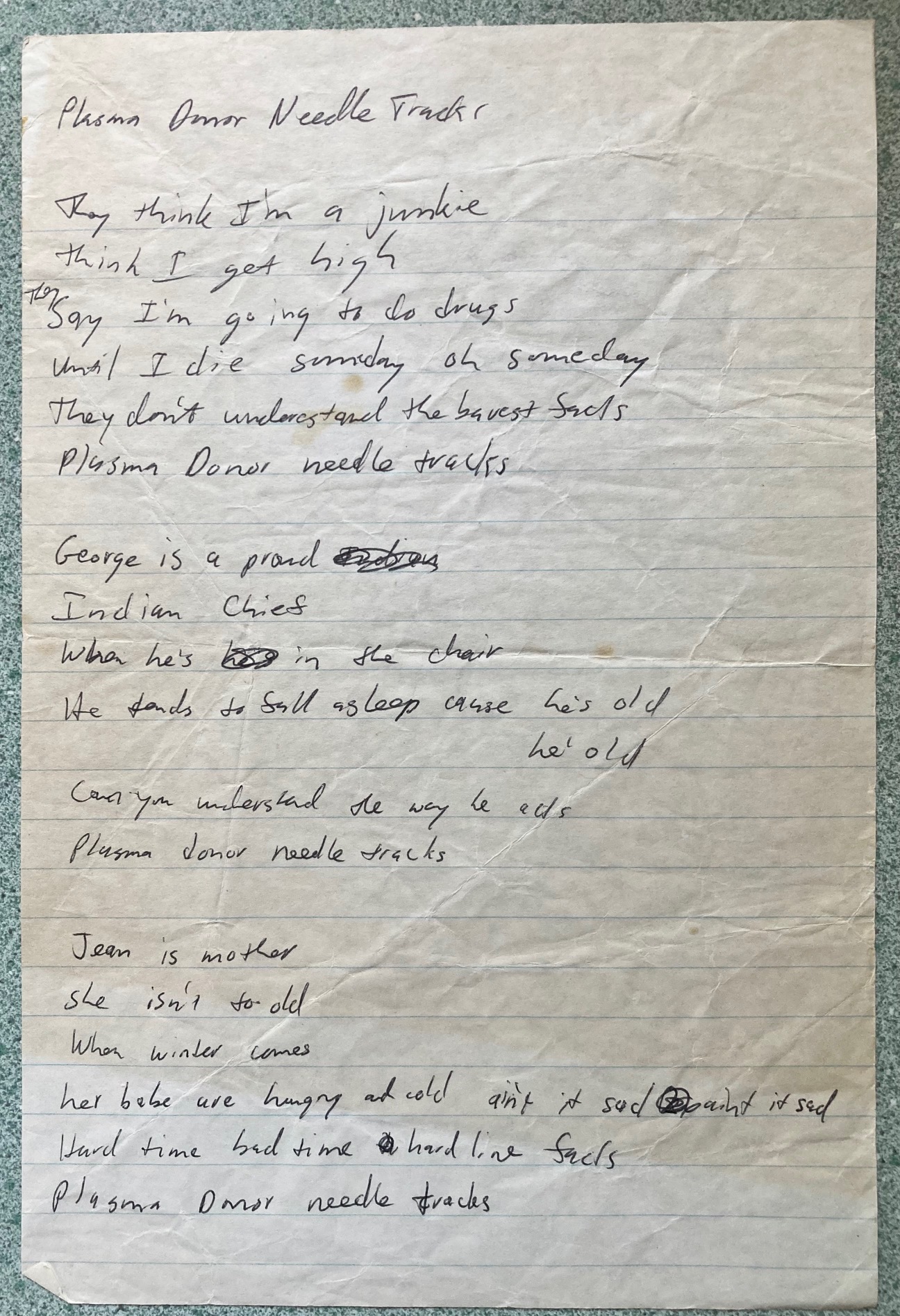
[Transcription: Front side of page]
Plasma Donor Needle Tracks
They think I’m a junkie
Think I get high
They say I’m going to do drugs
Until I die some day, oh some day
They don’t understand the barest facts
Plasma Donor needle tracks
George is a proud
Indian Chief
When he’s in the chair
He tends to fall asleep ’cause he’s old, he’s old
Can you understand the way he acts
Plasma Donor needle tracks
Jean is a mother
She isn’t too old
When winter comes
Her babes are hungry and cold, ain’t it sad, ain’t it sad
Hard time bad time hard line facts
Plasma Donor needle tracks
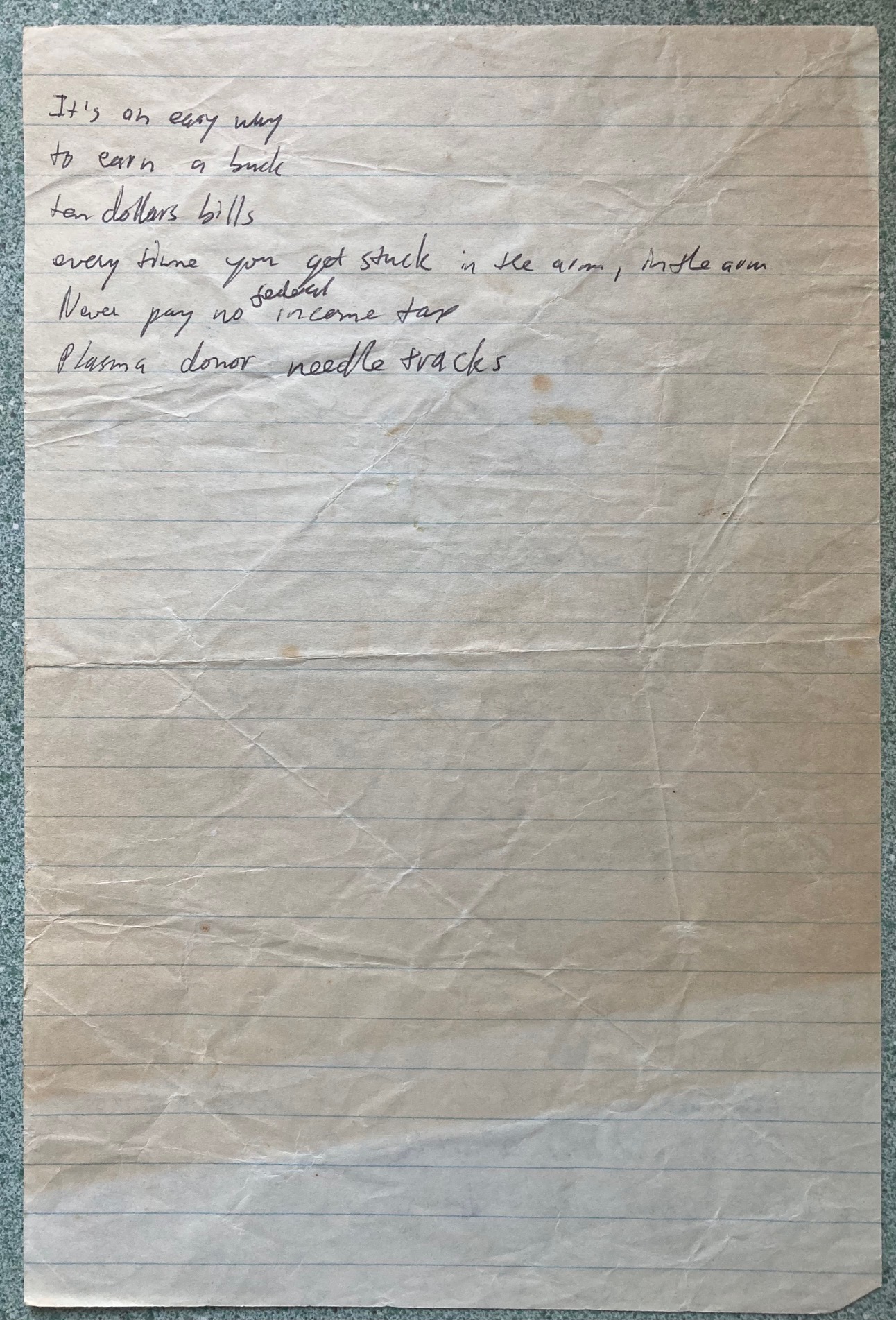
[Transcription: Back side of page]
It’s an easy way
To earn a buck
Ten dollar bills
Every time you get stuck in the arm, in the arm
Never pay no federal income tax
Plasma Donor needle tracks
1985 Version
By 1985, I was a few years away from Minneapolis and my girlfriend was now “former,” but the Plasma Donor song was still with me. In this spiral notebook, I wrote down a new version of the song. Compared to the original, I had discarded the verses about specific people and added an introductory verse and a verse about the experience of being a donor.
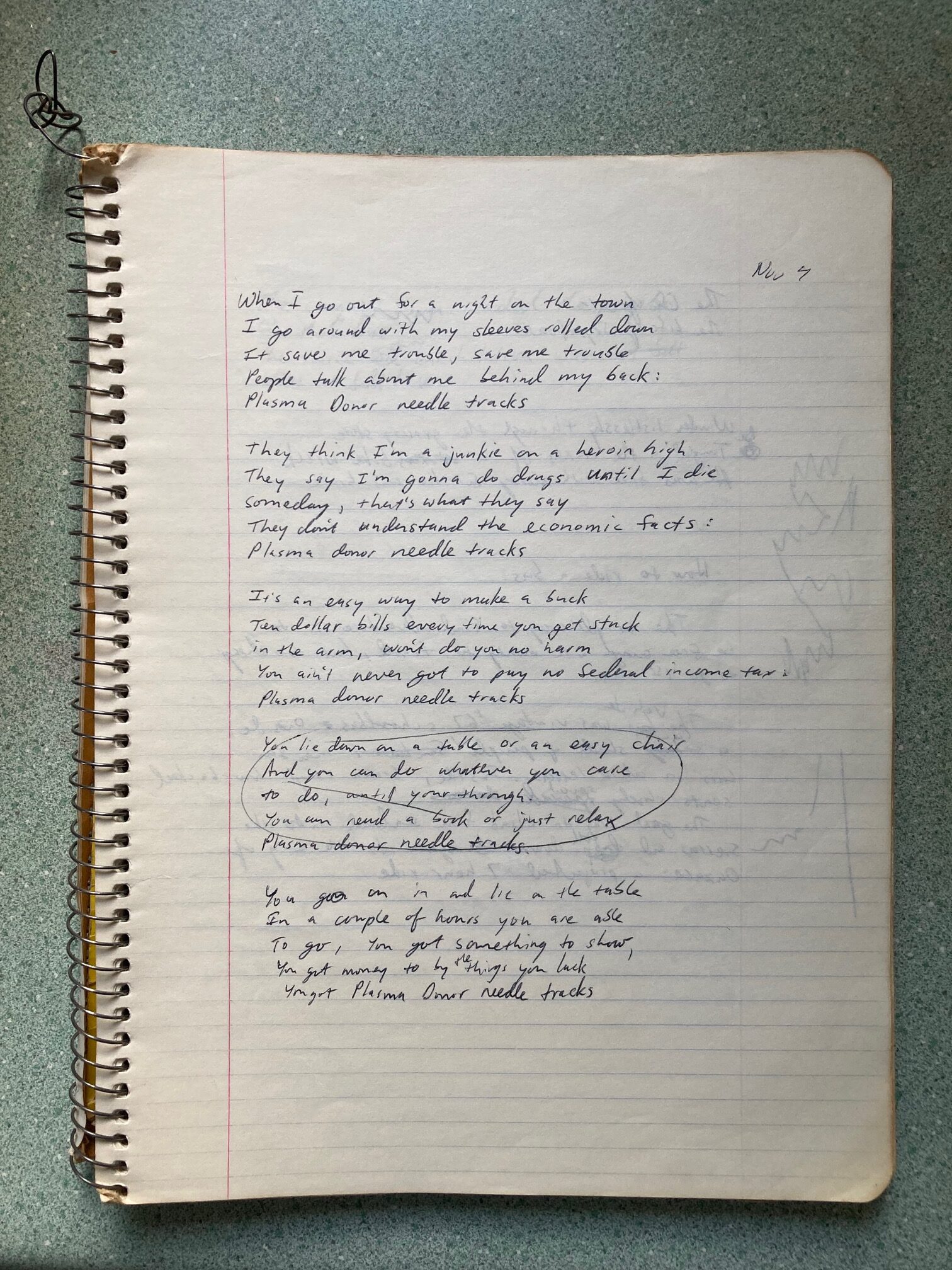
[Transcription]
When I go out for a night on the town
I go around with my sleeves rolled down
It saves me trouble, saves me trouble
People talk about me behind my back
Plasma Donor needle tracks
They think I’m a junkie on a heroin high
They say I’m going to do drugs until I die
Some day, that’s what they say
They don’t understand the economic facts
Plasma Donor needle tracks
It’s an easy way to make a buck
Ten dollar bills every time you get stuck
In the arm, won’t do you no harm
And you ain’t never got to pay no federal income tax
Plasma Donor needle tracks
[The next verse was crossed out and rewritten below — editing!]
You go on in and lie on the table
In a couple of hours you are able
To go, you got something to show
You got money to buy the things you lack
You got Plasma Donor needle tracks
Related Artifacts
Sheet music. In the same folder with the original lyrics, I found some of the music tablature from my guitar lessons in Dinkytown. This page is for the song Creole Belle, one of Mississippi John Hurt’s signature tunes, which was the type of music that people (including Dylan) were hearing and learning during the folk boom of the early 60s. (YouTube: Mississippi John Hurt singing and playing Creole Belle — definitely worth a listen!)
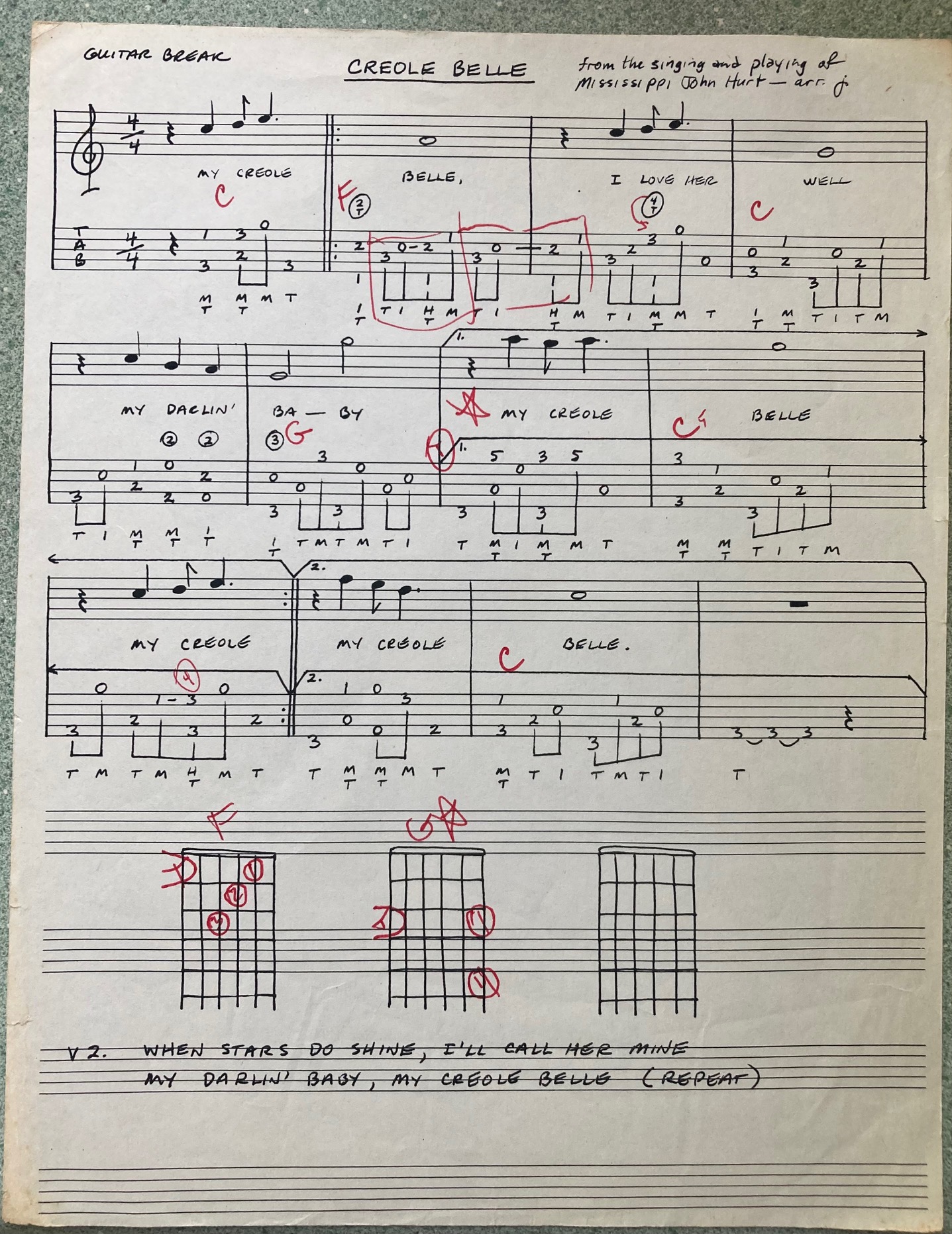
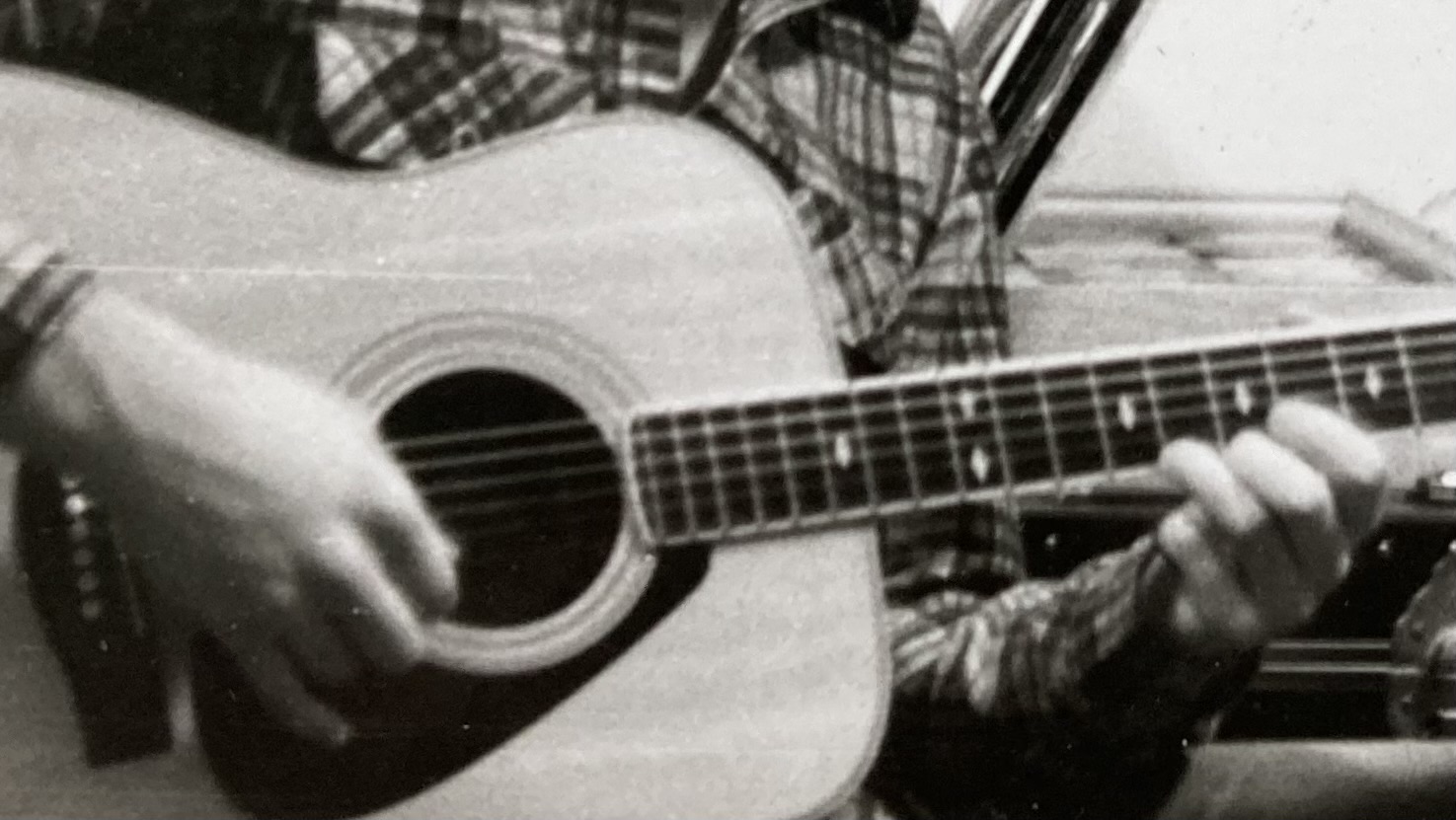
Photo. In another box of old treasures, I located a photo of me from the Plasma Donor era, taken by a friend in 1982 in his college dorm room. This photo ought to be on my first album.
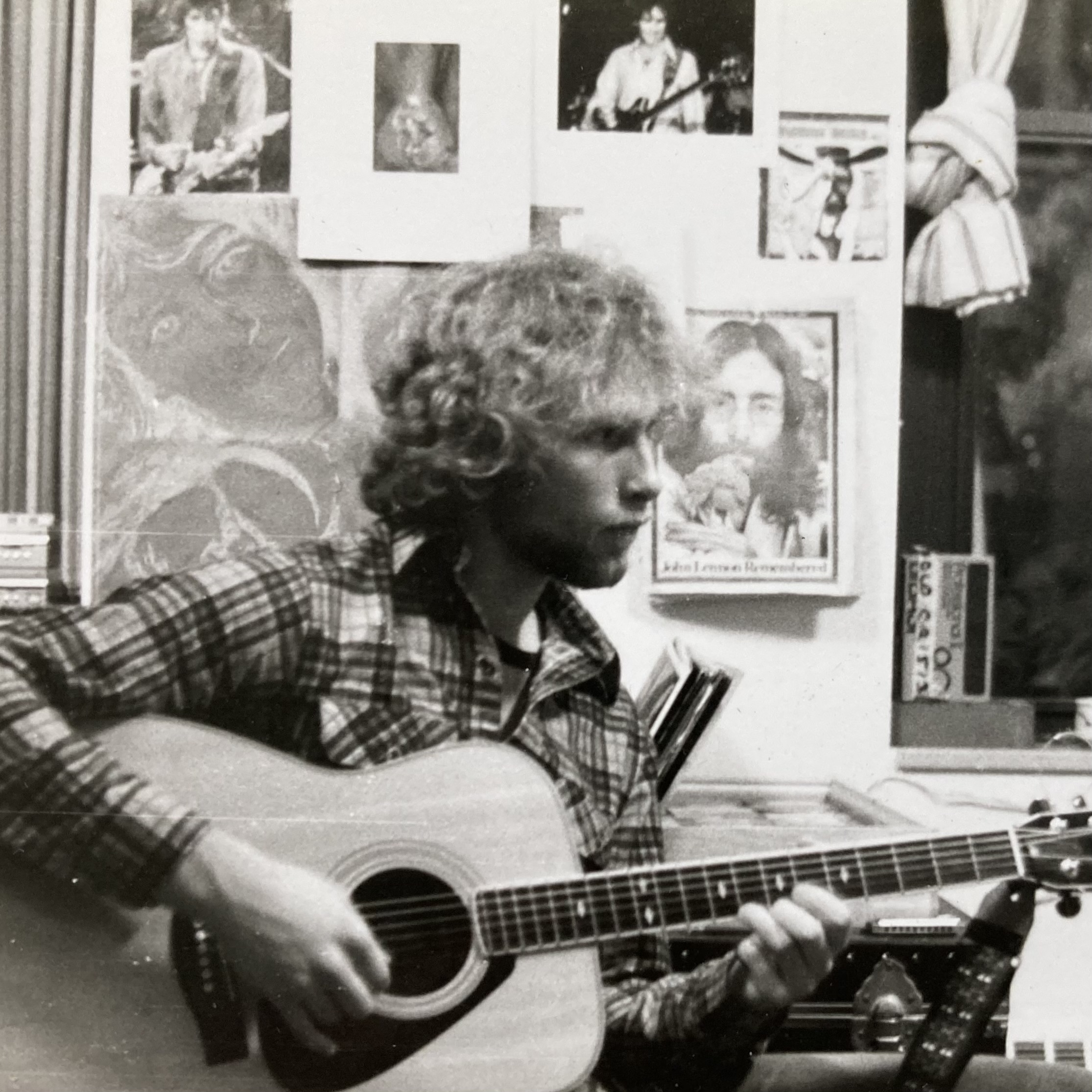
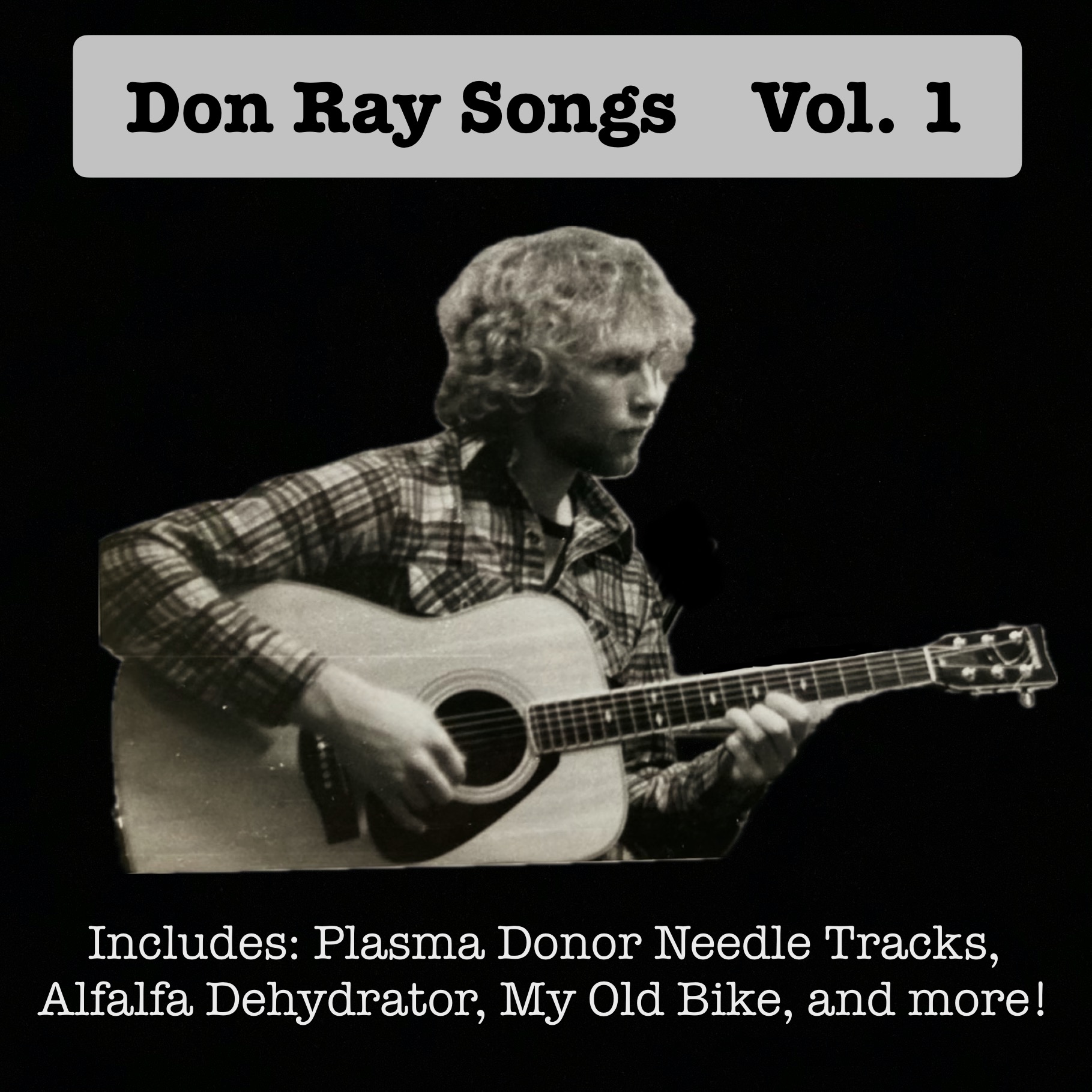
And that’s pretty much the whole story about the song. I’ll leave you with the theoretical cover of my theoretical first album: