
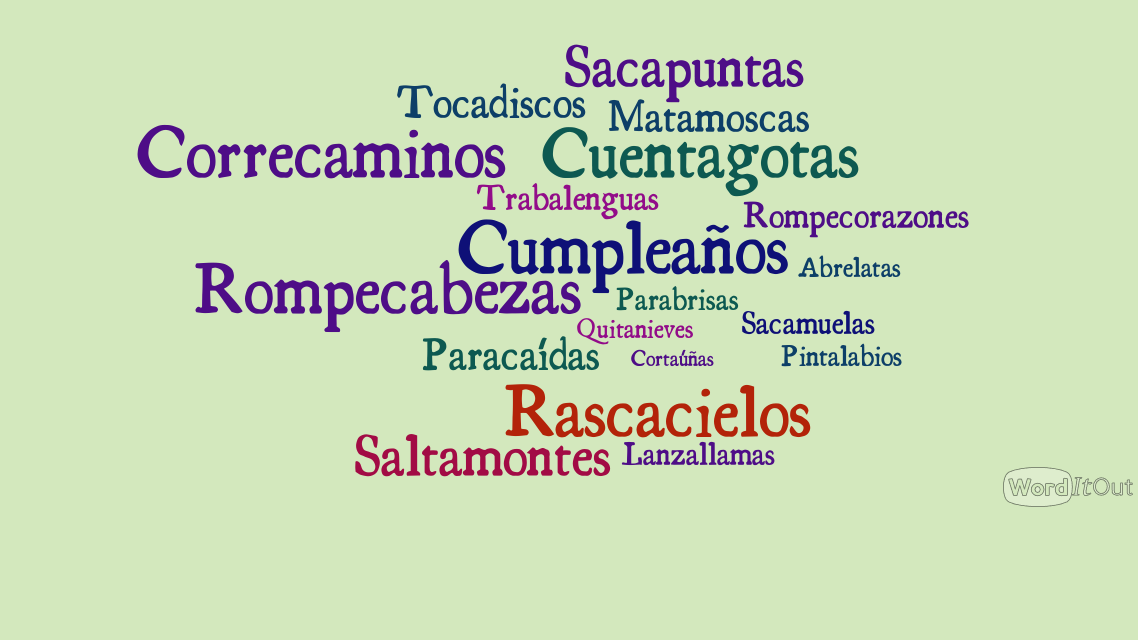
This topic is a “detour” in the sense that almost no typical beginning or intermediate Spanish course would cover it. But I used to do lessons like this when I taught high school Spanish. Taking this detour has value as another opportunity to grapple with important Spanish language features like gender of nouns, verb conjugations, and agreement of modifiers (including the most basic one: “the”). And the words themselves are FUN (believe me!).
Compound Nouns: Verb + Noun
(Note to the reader: This lesson requires only a basic knowledge of Spanish: present tense verb conjugations, gender of nouns, and forms of the definite article (el, la, los, las). After a brief explanation, there is an interactive portion where your brain will learn to work with the material.)
The compound nouns (words made up of two other words) that are most common in Spanish consist of a verb plus a noun. Many of these compound nouns have been created to name new inventions. Additionally, the base words are usually basic, everyday words.
With no further ado, here’s an example: el sacapuntas. Beginning Spanish students often learn this word because it names a classroom object: the pencil sharpener.
Let’s break it down: The components are a verb sacar (to extract) and a noun punta (a sharp point).
Those two words are combined in a predictable way:
1. The verb is in the 3rd person (she, he, it) present tense form; sacar is conjugated to saca (it extracts)
2. The noun is used in the plural form; punta becomes puntas (sharp points)
3. The resulting word, sacapuntas, is a noun with no separate plural form: el sacapuntas (the pencil sharpener), los sacapuntas (the pencil sharpeners)
4. The default gender of a noun of this type seems to be masculine, but there are exceptions. Regardless, the fact that the component noun punta is feminine has no bearing on the gender of the compound noun sacapuntas
To understand the approximate meaning of the compound noun, you can think of it literally; el sacapuntas is the “it extracts sharp points.”
Let’s look at one more beginning-level word to see that transformation again: el cumpleaños.. I’ll write the “equation” as you will see it below in the interactive section.
El cumpleaños
Cumplir (to complete) + año (year) —–> the “it completes years” —–> the birthday
Note: The Spanish word carries a significance not found in the word “birthday.”
Your turn!
Column 1 gives you a compound noun and provides the base words.
Column 2 gives you the literal meaning of the noun’s components. At this point, you should be trying to guess its actual meaning. Click for an image that will either verify your guess or help you make a better guess.
Column 3 provides the typical translation in English. Click to check your best guess.
1. El rascacielos.
Rascar (to scratch) + cielo (sky)

2. El correcaminos
Correr (to run) + camino (road)
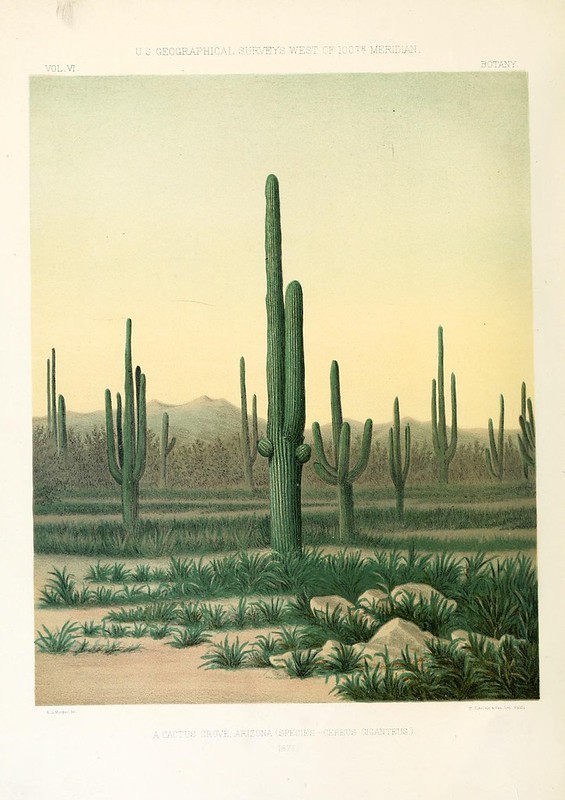
3. El parabrisas
Parar (to stop) + brisa (breeze)

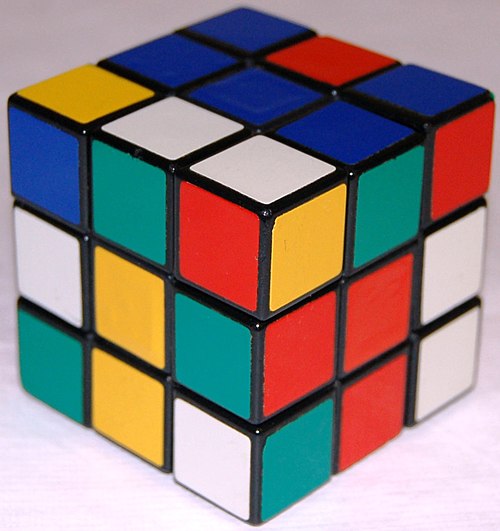
4. El rompecabezas
Romper (to break) + cabeza (head)
Further examples
Everyday objects:
el abrelatas (the “it opens cans”) — the can opener
el sacacorchos (the “it extracts corks”) — the corkscrew
el cortaúñas (the “it cuts nails”) — the nail clippers
el cuentagotas (the “it counts drops”) — the eye dropper
Examples you might read in the news:
el lanzacohetes (the “it launches rockets”) — the rocket launcher
el lanzallamas (the “it launches flames”) — the flamethrower (note: llamas in this case means flames, not wooly camelids from Peru!)
el portaaviones (the “it carries airplanes”) — the aircraft carrier
More examples from the word cloud image at the top:
el trabalenguas (the “it tangles up tongues”) — the tongue twister
el pintalabios (the “it paints lips”) — the lipstick
el saltamontes (the “it jumps hills”) — the grasshopper
el sacamuelas (the “it extracts molars”) — the tooth puller (or the dentist!)
el matamoscas (the “it kills flies”) — the fly swatter
el paracaídas (the “it stops falls”) — the parachute
el tocadiscos (the “it plays records”) — the record player
la quitanieves (the “it takes away snow”) — the snowplow (notice, at long last, a feminine compound noun!)
When People Are Involved
The gender of these compound nouns very often ends up being masculine when they refer to things. But when they refer to people, the gender of the word typically reflects the person’s gender.
Example: The bodyguard (“Hey, watch my back!”) is the guardaespaldas, from guardar (to guard) and espalda (back). The female bodyguard is la guardaespaldas, and the male is el guardaespaldas. The “the” (la or el) is the only difference between the terms.
Other examples:
la/el cuentacuentos (the “she/he tells tales”) — the storyteller
la/el rompecorazones (the “she/he breaks hearts”) — the heartbreaker
la/el vendepatrias (the “she/he sells fatherlands”) — the traitor
Complexities
What I’ve presented here is a “detour” from the typical path of Spanish instruction. Keep in mind that the detour has its own detours which we did not cover. In other words, there are always more situations, rules, sub-rules, exceptions, etc. But that’s normal in human language.
Grand conclusion!
Perhaps you have heard of a mysterious beast that kills livestock? Could it be the “it sucks goats”? Yes! Chupar (it sucks) + cabra (goat) —–> el chupacabras!
Interestingly (and logically), the word as borrowed into English usually lacks the “s” in the singular.
To their credit, the folks who made and translated Phineas and Ferb respected the ‘s’ difference between the English and the Spanish.
English: “Chupacabra Ho” (no ‘s’ in the singular)
Spanish (Latino): “Chupacabras Ho” (‘s’ in the singular)